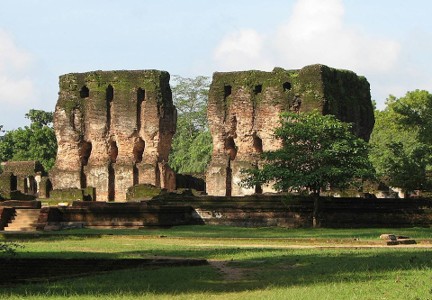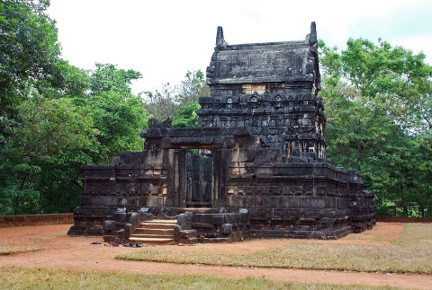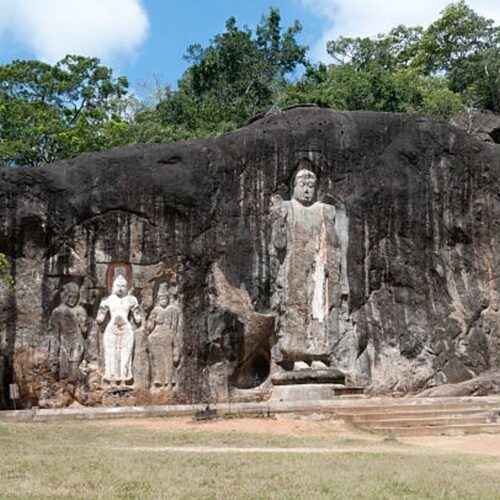
The undisputed masterpiece of Polonnaruwa is the Gal Vihara, a group of four sublime Buddha statues carved from a single granite boulder. The 14-metre reclining Buddha, with its serene expression and perfectly rendered form, is widely regarded as one of the greatest sculptures of the ancient world. The standing and seated figures display an extraordinary sensitivity to the human form and spiritual presence that rivals the finest works of any civilisation. The Royal Palace of King Parakramabahu I, though now reduced to its massive brick foundations, once rose seven storeys and contained over 1,000 rooms. The nearby Audience Hall features beautifully carved stone reliefs of elephants, lions, and dwarfs. The Lankatilaka Image House, with its colossal standing Buddha and soaring brick walls, creates an awe-inspiring space that still impresses visitors.
The Parakrama Samudra, an enormous reservoir whose name means ‘Sea of Parakrama’, irrigates over 9,000 hectares and stands as testament to the engineering prowess of King Parakramabahu I, who declared that not a single drop of rain should flow to the sea without benefiting the land. The Vatadage, a circular relic house with elaborately carved moonstones and guardstones, exemplifies the refined aesthetic of the era.
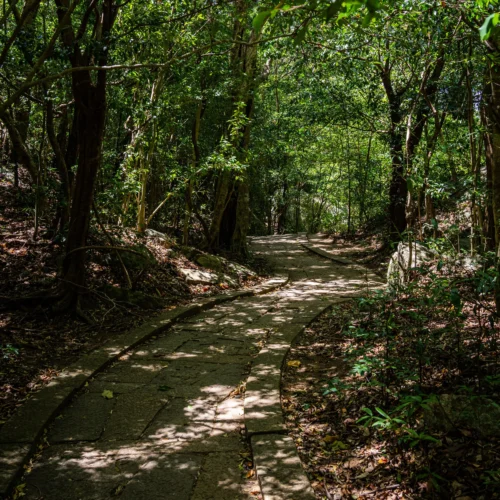
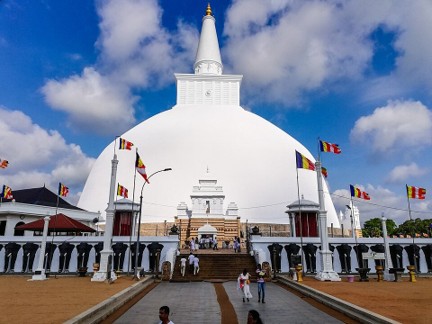
The Rankoth Vehera, the largest stupa in Polonnaruwa, and the Kiri Vehera, still retaining its original white plaster after 800 years, demonstrate the enduring religious devotion that sustained the kingdom. The Shiva Devale No. 2, the oldest Hindu temple in Polonnaruwa, reflects the South Indian Chola influence that shaped the city’s cultural landscape during periods of occupation. Unlike Anuradhapura’s vast spread, Polonnaruwa’s relatively compact layout makes it possible to explore the entire site by bicycle in a single day, adding a charming dimension to the visit. The well-preserved monuments, combined with the shade of ancient trees and the green expanse of the Parakrama Samudra, create a uniquely atmospheric experience that transports visitors back to Sri Lanka’s most culturally brilliant era.
Polonnaruwa, Sri Lanka's medieval capital and a UNESCO World Heritage Site, represents the golden age of Sinhalese civilisation following the decline of Anuradhapura. Flourishing between the 11th and 13th centuries AD, this compact but magnificent city showcases some of the finest achievements in ancient Sri Lankan art, architecture, and engineering.
This comprehensive 14-day private tour takes you through the very best of Sri Lanka, from ancient sacred cities and UNESCO World Heritage Sites to misty...